Saturday, 15 August 2020

Mackenna's Gold


Since times immemorial, man's quest for the yellow metal gold has remained unquenched.  There are innumerable stories, real and fictional built over the search for gold.  One such story, 'Mackenna's Gold', the blockbuster movie of the year 1969, is indelibly etched in the memory of we seniors, since long.  Do you believe that this movie was a box-office failure in the country of its origin US?  Call it the trigger provided by the 'craze for gold,' the movie was a huge success in the Indian Subcontinent! Later, the film continued its super gains in the erstwhile Soviet Union (present Russia was its major part) and other countries of central Asia.
People in America believed that there was a huge treasure of gold hidden in the 'canyon del oro,' located in their south-western parts.  (A 'canyon' (pic above) is a deep valley created by soil erosion from a flowing river). The treasure was believed to be guarded by 'Apaches,' native American tribes.
Colorado (played by Omar Shariff, first man behind), an outlaw from Mexico with his team of more outlaws and tribals, was in the treasure hunt.  On the way he captures Mackenna (played by Gregory Peck, seen in the front above), who knew the route to the location of the treasure. One more team led by Ben Baker, which also was in search for the treasure, forces its way into Colorado's team.  Colorado's team was chased by another team of men on horseback led by Tibbs.  

Tibbs' army kills most of Colorado's men, and finally they too force their way into Colorado's team.  One day the warring factions reach the 'shaking rock,' behind which they find the huge treasure of gold.  The leader of the US-army Tibbs, loads saddle bags on either side of his horse with the gold nuggets (irregular pieces), but gets killed.  
In the commotion that followed, 'shaking rock' falls, triggering a mini-quake resulting in the deep burial of the huge treasure.  In the final fight, Mackenna overpowers Colorado and reaches Tibbs' horse having two saddle bags of gold.

Mackenna and Colorado, if they were to be alive today, they would have again ventured to dig the buried treasure of gold.  The gold price has shot up this year by a whopping 43%, and many of us are repenting for not having invested in gold earlier!  'Why gold price has shot up like this,' is now the most discussed topic. Let's try to find the reasons.

1) Pandemic Covid-19:
Pandemic Covid-19 has crushed the economy of the entire world.  Almost all countries are implementing huge relief packages triggering inflation.  To mobilize resources governments are liberally printing currency adding to the sky-rocketing rates of inflation.  In such a situation, people are investing in gold as a stable alternative.

2) Falling interest rates:
Since the outbreak of the pandemic, interest rates are falling all across the world and as a corollary, the gold price is shooting up.

3) Stock markets are defying the pandemic logic.
In spite of the pandemic pull down, stock markets are continuing to rule high! Several scrips are above their average value still.  This anomaly has pushed people to buy gold as a better alternative.

4) Gold mining has been affected due to lockdowns.  This in turn has brought down the production of gold, resulting in a fall in its supply.  This obviously has pushed the gold rate up.

During the recession of 2008, we saw unprecedented rise in the price of gold.  It has further registered a huge gain now, due to the pandemic effect.  Whether gold will hold on to its present value is a matter of speculation.  

People investing heavily in gold is not good for the economy.  It only results in squeezing of liquidity, much needed for the development of the economy.  People all over the world are hoping that a Covid-19 vaccine would be ready soon, which is the only hope to end the uncertainty.  
-0-0-0-
Tail Piece:
My e-book 'INDIA, DEFEAT CORONA' is received well.  I am happy to convey you all that I am receiving encouraging feedback.  The book is available at http://www.pustaka.co.in/home/ebook/english/india-defeat-corona  It is also available on 4 more leading book sites of the world including 'Amazon'.  Amazon even allows download of 'free sample.'  I look forward to your feedback on my book.


Saturday, 25 July 2020

My forthcoming e-book on Corona


A few highlights
1) Name of my forthcoming 'e-book on Corona'
     - Yet to be announced. (to be published on Amazon/or 
        Pusthaka.com
2) How Big? 
     - About 55,000 words, contained in about 250 pages spread over
       14 chapters.
3) Special feature
    - 15 illustrative cartoons by our  Country's well known    
       cartoonist Mr. Raghupathi Sringeri N.S. (Cartoon above is
       his piece of art).
4) When it will be released?
     - Next week!
I request you all to encourage me by reading my book.

An excerpt from my forthcoming book........

A day before the light event, to herald the launch of our Country's fight against the Covid-19 pandemic, our Prime Minister Narendra Modiji quoted a poem of his mentor and former Prime Minister Atal Bihari Vajpayee, which highlighted the significance of lighting a lamp.  The poem read......
Hindi Version

Aao phir se diya jalayen
Bhari dupheri mein andhiyara
Suraj parchyi se hara
Antartam ka neh nichude
Bujhi hui baati sulgaye
Aao phir se diya jalayen
                                                                                                                                                                                                     
Hum padaav ko samjhe manzil
Lakshay hua aanko se ojhal
Vartaman keh mohjaal me
Aane wala kal na bhulaye
Aao phir se diya jalaye

Aahuti baki yagna adhura
Apno ke Vighno ne ghera
Antim jaye ka wajra banane
Nav Dadheechi haddiyan galayen
Aao phir se diya jalayen 

-0-0-0-


My English translation


At the time of this darkness during the afternoon
When sun is covered by shadows
Let us take out as oil, the darkness within our mind and body
To re-kindle the flame instead
Let's light the lamp together again

We mistook the milestone for the destination
Our goal has become out of sight
In the mundane trappings of the present
Let's not lose sight of the coming tomorrow
Let's light the lamp together again

The sacrifice is pending, the yajna* is incomplete
Engulfed by the obstacles born from our own men
To make the vajra for the final victory
Let our modern Dadheechis* donate their backbones
Let's light the lamp together again


(*Yajna is a Vedic ritual in Hindu tradition, which is done as sacrifice or offerings, composed of ingredients like ghee, to a sacred fire with the objective of invoking good for the society.  Fight against coronavirus is symbolized here as Yajna).

(*Vajra stands for Vajrayudh, a weapon which God Indra had used to kill a demon).

(*Dadheechi was a saint who donated his backbone to God Indra, to be made as  Vajrayudh).
-0-0-0-

'I have not seen or heard Vajpayeeji.  Did he write this poem? when and                 why?’ was young Rohini's (Main lady character of my book.  She is a young lady with a rational mind) reaction.  Now it was time for father Raju (he is the father of Rohini.  He is like any one of us) to take full scope in explaining the relevance of Atalji and his poem to his daughter. 

 'Vajpayeeji was our Prime Minister.  More than a politician, he was a great orator and a poet.  Many during his lifetime, used to say that “Vajpayeeji going to politics, was a great loss to the world of literature.”  In spite of his very active political life, both as an opposition leader and the Prime Minister, he kept time for giving vent to his literary skills too.  The quoted poem was aimed at the youth of our country, symbolized by the afternoon sun, which is covered by the darkness of clouds.  But our young men are energetic and enthusiastic.  Their march on the track should not be disturbed by obstacles of the present day.  In view of a bright tomorrow, they should continue to fight together (Yajna) by lighting the lamp of hope. Our modern youth, like “saint Dadheechi,” should sacrifice their time, intellect, and energy to the ongoing fight for ensuring the welfare of mankind.  Full marks to Modiji, for a timely quotation of the poem and calling upon our people to light the 'lamp heralding our fight against the pandemic,' averred a beaming Raju.  Combative Rohini was now subdued and nodded in appreciation of the great spirit of the poem. 
 
It was 9 pm on Sunday, the 5th of April 2020.  Lights went off and people came out of their houses. Rohini too joined her father in lighting the lamps and candles responding to the call of the Prime Minister.  A few even blew the conch and fired crackers.  It was virtual 'Diwali, the Indian festival of lights' replayed.  Modiji himself was at the forefront of lighting the lamp, wearing a 'mundu' (a rectangular white cloth used to wrap around the waist, also called dhoti) and draped in an Assamese 'gamusa' (a rectangular white cloth with red borders draped around the neck).  The nation-wide lighting of the lamps symbolized the country's resolve in being together for the fight against Covid-19.
-0-0-0-0-0-0-

Saturday, 11 July 2020

Prayer Vs Pandemic!

Aditi Joglekar was a teen aged girl.  She was an ardent student of Hindustani classical music.  28th February, was the birthday of her first musical guru and her grandmother late Sulabha Joglekar. It was time for Aditi to recall the fond memories of her grandma.

Mercurial Sulabha Joglekar was passionate about many things.  Besides, classical music she was very much interested in handicrafts, painting and fashion designing too.  She was very much fond of black rabbits.  A few years before her death she had brought a black rabbit which was very cute.  She used to call it by the name 'Shalu.'  Towards the days of her waning health, 'Shalu' had become her only companion. There was a century old story behind 'Shalu,' the black cat remembered Aditi!  

Sulabha Joglekar, was born in the year 1909.  Her father Dinanath was working in a saree weaving factory, in a village near Bombay.  When she was seven years old, Sulabha's mother, had brought her a black rabbit.  Sulabha had named her 'Shalu.'  Sulabha grew happily with Shalu for two years.  But Sulabha's father Dinanath hated pets.  Just because of the love of his daughter, Dinanath was tolerating Shalu's disturbances.  Moreover Dinanath believed that black rabbits were ominous and they bring bad luck to the family. Therefore one day Dinanath took away Shalu, the black rabbit and left it in a nearby forest.  Sulabha was very much upset and was missing Shalu very much.

It was the month of August during 1918.  Now, Sulabha was nine years old.  One day, when Sulabha was coming back from the school along with her 3 elder sisters, there was heavy rain.  All the four sisters were soaked in rain.  Sulabha's mother had to wipe the heads of all his daughters with a thick cloth.  When the daughters woke up the next morning, all the three elder sisters of Sulabha were running fever.  Disturbed Dinanath checked up with the neighbouring panditiji (village doctor who practices with herbal medicine).  Panditiji gave some medicine, but warned Dinanath to be careful because there was a peculiar fever around, which was not subsiding easily.  There were rumours that a strange disease was spreading through soldiers, who were returning from              "world war I," through ships reaching Bombay. Therefore people had started calling it 'Bombay fever.' Government had warned people to be cautious about a disease called the 'Spanish Flu,' which was highly contagious and deadly.

Sulabha's sisters' fever never subsided.  Within two days, they all started bleeding in the nose.  They used to gasp for breath.  During the same week, Dinanath was also down with  the similar disease. Several cases of similar ailments were reported all across Dinanath's village. The village pandithji was going around giving medicines to all the sick people.  Pandithji was advising people to inhale steam every three hours during day time, take boiled milk with turmeric and drink plenty of hot water.  Those who could, were advised to  stand in sunlight everyday, for about 20 minutes. He had also warned people to maintain distance between individuals, as the chances of the spread of the unknown disease were very high.
Pandithiji advised people not to lose hope and keep praying God. He was of the opinion that faith and hope are two great immunizers and healers too! Pandithiji used to tell people that faith leads to prayer, prayer leads to confidence and confidence was the most essential factor, in ensuring early cure. All villagers had great faith in pandithji, and they were religiously sticking to his preachings.
But not much improvements were seen. Reports of large number of deaths were heard from the neighbouring villages. Sulabha's mother was caught up with the fear of losing her husband and daughters. Innocent Sulabha had said to her mother then, 'sending away Shalu, my rabbit has brought bad luck to our family.'  Sulabha's mother had no answer.  Mood of the entire village had become gloomy.

One day Sulabha and her mother had gone to the forest to bring some fire wood.  When Sulabha was looking around, she was thrilled to find Shalu, her black rabbit.  Shalu came running to Sulabha.  Sulabha was extremely happy to take Shalu back to her home.  The very next day Dinanath was relieved from fever.  Within a couple of days all the  three sisters of Sulabha too were relieved from illness.  Happy days were back for the family.  Sulabha said to her father that good luck has come to them with the return of Shalu, the black rabbit. Dinanath had to nod in approval.  

Barring three cases of death, 27 people had recovered in the village.  Pandithji of the village received a special award from the local King for saving lives. 

More than 100 years ago, when the world's worst pandemic 'Spanish Flu-1918 broke, India was also severely affected.  In an era, when modern treatments were unheard, a village pandithiji, could save people with his humble medicine.  Pandithiji boosted villagers confidence with the super medicine called the 'prayer!' In this modern era of negative news from all media sources 24x7, has this story a message for us? Can avoiding listening to depressing news and retaining our confidence, help us in boldly facing the present pandemic?  I appeal for reactions from my readers.
-0-0-0-0-0-0-0- 

(I have written this short story, to be included in my forthcoming book 'India fights Corona.')

Sunday, 10 May 2020

ನಿಸಾರರಿಗೆ ನನ್ನ ಕವನ ನಮನ


Mahabharat in Corona Times!

War against Corona began with the lockdown imposed since 24th March.  Telecast of the epic-serial Mahabharat (and also Ramayan) too was started from 28th March as if to supplement the effort in enforcing the lockdown.  More than thirty years ago these two great serials virtually had the power to confine entire India to their homes. 

War in Mahabharat was towards the end, whereas the Corona story has begun with the war itself! Our doctors and other paramedical staff are our front line warriors against Corona.  They are virtually working 24x7 staying away from their families for weeks together.  The story of the Belagavi
nurse Smt. Sugandha Korikoppa who could only shed tears from a distance on seeing her 3-year old daughter has melted the hearts of every one of us.  Such are the compulsions of the medical profession. Such high ideals for the nursing profession were laid by
Florence Nightingale, whose bicentennial birthday falls on 12th May.  The day is also celebrated world-wide as the international day of nurses. Florence came to limelight when she was the nurse in charge of care of the wounded soldiers during the Crimean war 
between UK alliance and Russia.  Popularly called the 'lady with the lamp', Florence, the succour of hope for the wounded soldiers is regarded as the 'founder of modern nursing'.  As a mark of respect to her services, nurses all over the world take their professional oath in her name.

The stories of many of our warriors themselves succumbing to Covid-19 are really unfortunate.  These brave hearts have never relented from their duty, although they knew that they run high risk of contracting the deadly virus.  Perhaps they were guided by the greatest lines of
from Bhagavatgeetha, which exhorted them to do their duty, leaving the consequences to the God.
Dr.KM Ismail Hussain, the founder of KM Hospital in Kurnool, AP was popularly known as 2-Rupee doctor.  Throughout his life of 79 years he served the poor irrespective of caste or religion.  While being on duty in treating Covid patients, he contracted the virus and died on 14th April.  May his spirit keep guiding us.


I am sure that with the help of our brave Corona warriors, India and the world are bound to win the war against Corona.  We as common men will certainly take note to contribute in all possible forms.

Corona crisis is not without positives.  Lockdown has shown us the way to rejuvenate the environment.  The scenes of clear Ganga and 

Himalayas visible from more than 200 kms are all welcome lessons. Mahabharat too has a great lesson on environment.
When brave Arjun, Bheem, Nakul and Sahdev disregard the sanctity of the Yaksha's pond while drinking its water, they had to pay by laying their lives.  Are not ponds and other water bodies asking us questions today?  Do we pay heed to preserve them? 
If we ignore their silent sufferings, will it not lead us to death?  When Yaksha offered to bring back to life at least one brother, Yudhistir requested to save his step-brother Sahadev first.  Even now, during such challenges our Corona warriors have certainly shown the way by ignoring their families, while rushing to save patients.

Corona lockdown has kindled the creativity among people.  People are taking to reading, writing and even coaching children.  TV serial Mahabharat has provided all of us the food for thought.  
For seniors like me the feeling is nostalgic, as the serial is a rerun from the times of our youth.  They say history repeats!  How true it is?  Like in Mahabharat, the Indo-Pak story is the story of conflict 
between two brothers. There was partition even during Mahabharat.  During partition of India, mediation was done by the British, but there was no such mediator in Mahabharat. India had leaders like  Yudhistir (Dharmaraj), who were ready to concede almost all terms demanded by the other camp. Like in Mahabharat, partition could not ensure peace and the war/s followed. With the passing away of veterans, accepted norms were thrown to the wind then, and it is happening even now.  All stakeholders have to realize that there can be no winner in a war. We all have to learn to live together in peace.

Thanks for reading.  Your comments are most welcome.
-0-0-0-0-0-0-


Tuesday, 14 April 2020

Can Ramayana Kill Corona?

The best step forward to contain Corona was the 21-day Lockdown imposed on the entire country from 25th March.  As if to supplement this great step, Doordarshan started re-telecasting its super epic-show Ramayan.  Within no time, Doordarshan has regained its top position as the most popular channel!  Has Ramayana killed Corona?

Outbreak of Covid-19 about two months ago has immersed the entire world into a gloomy mood.  The concern is more acute in our Country which has a huge population with minimal medical facilities.  People confined to their homes are fed 24X7 with scaring news about spread of the disease.  Some psychiatrists have advised people, especially seniors and children to stay away from viewing Corona news.   Ramayan has certainly provided the much needed diversion to people from the sense of gloom. Let us recall the noble thoughts enshrined in Ramayan whose appeal is universal and eternal.  
The initial hesitation and then the wise decision by King Dasharath to send Ram and Laxman along with Saint Vishwamitra holds a great lesson for modern parents and our youngsters.  There comes a time when youngsters have to be launched into the real world to fight for themselves.
Poor succession plans have killed business houses!  King Dasharath was no exception.  His timing was wrong when Bharath and Shatrughan were away.  Without informing all stakeholders, hurriedly he planned Ram's accession to power and had to pay the price. Clever Ram found opportunity in adversity.
After losing Seetha, Ram felt helpless and looked for strategic alliances.  He forged friendship with Sugriva whose wife too was taken away by Vaali.  Ram dreamt that Sugriva's army of 'vanaras' can be formidable.  Ram further chose Hanuman as his special assistant for all dire needs. 
In order to strengthen his relationship with Sugriva, Ram killed Vaali by deceit, which has remained as a controversial remark on Lord Ram even today.  As the rift between Vaali and Sugriva was only because of a misunderstanding, diplomatic Ram could have tried easier option of reconciliation first.  Sometimes in a war strategy,  means takes a back seat while achieving the end!
In his maiden interactions with Ram, Seetha and Ravan, Hanuman proves to be a master communicator.  He avoids suddenly appearing before Seetha.  Instead hiding Hanuman starts reciting Ramayan and at right time drops down Seetha's ring.  He cleverly reminds Seetha that she had given the same ring to Lord Ram to be given as a gift to the boatman.  He speaks positively to fill Seetha's mind with hopes of early relief.
As a clever emissary Hanuman creates opportunity to meet Ravan and test his strength.  When Ravan chooses to humiliate him by firing his tail,  Hanuman pays back by setting fire to entire Lanka.  
Ram builds the bridge across the sea by utilizing the minimum resources of material and manpower at his command. Wisely he assigns the task to Nal and Neel who were proven engineers at his command.  
Compared to Ram, Ravan had all sources at his command.  But he had chosen the wrong path and ignored all sane advice. He totally rejected Vibhishan's advice and humiliated him.  Losing Vibhishan to enemies camp was probably Ravan's biggest strategic mistake.
 Averting a war is better than even winning it.  Ram chooses to send Angad as his emissary for one last time.  Adamant Ravan never realizes!
Kind Ram rushes towards dying Ravan to bless him.  Ravan summarizes his tragedy by telling Ram, 'Oh, Ram you are nothing before me.  You won because your brother Laxman was with you, and I lost because my brother Vibhishan was not with me'.  
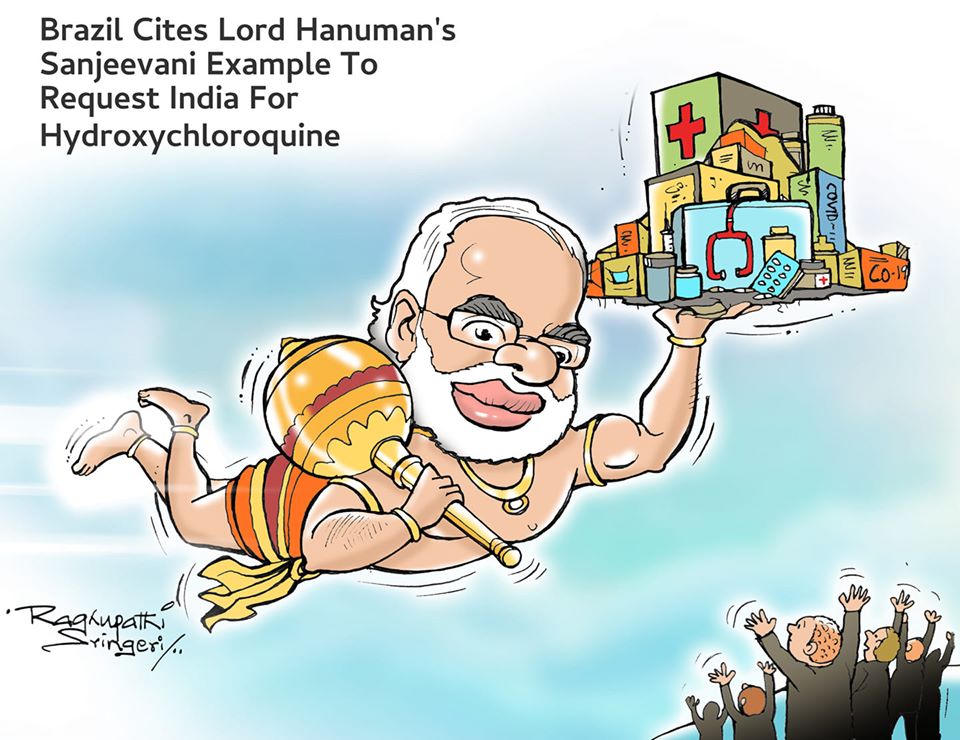
(Cartoon Courtesy: Mr.Raghupathi Sringeri)
Ramayan's relevance is universal and eternal.  Brazilian PM moved our PM Modiji by quoting Hanuman who brought 'sanjeevini' to save Laxman and he rightfully got his quota of the much needed 'malaria drug' from India.  

As revealed by media, Ramayan has once again gripped the entire nation with positive thoughts, among all sections including men, women, seniors, young and children.  It has provided the much needed diversion from negative thoughts of Corona, which in itself is a victory over the disease.
Jai Sri Ram
-0-0-0-0-0-0-


Saturday, 21 March 2020

Deadlier than Corona!

Invisible virus Corona has shaken the entire world!  Till yesterday, it has engulfed 154 countries, infected 2,86,932+ people and killed 11,906 persons.  Italy's figures of 793 deaths (on 21st March) is scary. World's most powerful country USA is virtually shut down with fears of fatal spread. With only 315 infections and 4 deaths, India's figures are only looking deceptive.  Experts have warned that coming days are very crucial!
Virus attacks on mankind is not new.  The worst of them is the 'Spanish flu 1918' which lasted for 2 years till end of 1920.  Its attack period virtually extended the disastrous effects of World War I (1914-18). Spanish flu's death estimate of about 50 millions to 100 millions (about 5% of then world's population) had virtually eclipsed the first World War's toll which killed 9 millions soldiers and 7 million civilians.  Even in India about 15 million people became victims due to Spanish flu. 
Spanish flu was first of the two pandemics caused by H1N1 influenza virus, second being the 'Swine flu' of 2009. Doctors unsuccessfully tried to cure it with 'aspirin'.  Ultimately the virus weathered down on its own.  Strangely Spanish flu killed more youth and the middle-aged than the old!

Virus attacks are natural and man can do little to avoid their occurrence.  Unfortunately man-made disasters are bigger killers than the virus attacks. 
Road accidents kill about 1.5 million people every year around the world and the figures are ever increasing.  90% of these deaths occur in low and middle income countries and most killed are young people.  The reasons for road accidents include rash driving, bad roads, liquor consumption and over-crowded roads. 
Surprisingly the biggest killer of mankind is 'hunger'.  As per UNO estimation, about 800 million people, the world over suffer from hunger which is more than 10% of world population.  About 25,000 people die every day because of hunger, which adds up to about 10 million deaths every year.  
Both the vaccine and the medicine for combating hunger are known to all of us. That is providing them food!  But not many care for this easy solution as hunger kills only poor whereas virus kills even the rich!
Hunger is rampant in Asian and African countries.  Hunger in children causes stunted physical and mental growth affecting the entire generation to come.  Mothers who are malnourished invariably give birth to weak children.  An interesting observation is that the education level of the mothers greatly influences the level of nourishment provided to children.  As per one study India is faring worse than her smaller neighbours, Srilanka and Bangladesh in combating hunger, malnutrition and child mortality!  
As per another estimate every year, food worth 750 billion dollars are wasted all over the world, whereas food worth 30 billion dollars annually is enough to combat world hunger! Strange that the mother earth is providing food for all, whereas man does not know how to make it reachable to the needy.  

All these doesn't mean that we can downplay the threat of Corona.  Let us take a pledge today on the occasion of  'Janata Curfew' to resolve and restrict ourselves for combating the ugly virus.  
Let's clap, ring bells and blow conchs at 5 pm today from our roof-tops, for thanking all those who are working tirelessly for fighting Corona.
Short live Corona!
Long live mankind!!
-0-0-0-0-0-0-