Saturday, 27 January 2018

National Year of Millets - 2018

A couple of years ago a family friend suggested us to try millets in order to have a better control on diabetes. As I am diabetic for over a decade, my wife took special interest in this experiment.  On    day-1, as usual I had 3 rice-dosas  and checked for sugar level post breakfast, which was about '195'.  On day 2, we prepared millet dosas and I consumed 3 dosas and checked for sugar level post breakfast. We were pleasantly surprised when it read just '135'! Since then millet dishes have become a regular feature of our family diet and we are witnessing consistent results.

Karnataka leads.....
Karnataka is leading in millet cultivation.  Both the Government and farmers are taking special interest in spreading awareness about the good effects of millets consumption.  Just 4 years ago, area under millet cultivation was just 4000 hectares and today it has reached 94,000 hectares rising the hopes of Karnataka farmers!  Today in almost all grain shops in Karnataka, various types of millets are available for sale.  Shopkeepers say that the sale of millets is picking up day by day.  Buoyed by all these developments, Karnataka Government took initiative to hold the 3-day 'Organics & Millet 2018 International Trade Fair' at Bengaluru (19-21 Jan 2018).  This grand mela was well attended and the much impressed Central Government has declared the year 2018, as the 'National Year of Millets'.

What are Millets?
Millets are being cultivated since more than 10,000 years especially in Asia.  Millets are a group of small seeded grasses (see pic.above) which are drought resistant and grown on dry land. They are short term crops.  Their cultivation cost is said to be very economical when compared to the high water consuming rice and even wheat! In this era of ever decreasing rainfall, switching over to millet cultivation and consumption may be the answer to fight shortage of water. As per one study 4000 litres of irrigated water is required for producing 1 Kg. of rice whereas this cost is virtually zero for millets, as its cultivation is totally rain-fed!


Presently millets are being sold in shops at a price of about Rs.70-80 per Kg giving good relief to our ever suffering farmers.  Compared to the traditional crops of rice and wheat whose cost of cultivation is very high, millet cultivation is  ensuring better profit to our farmers.
One of the pioneers in popularizing millets as staple food to control diseases and improve health, is Dr.Khader (see pic above), Food & Nutrient expert from Mysuru. He claims that switching over to millet diet for six months can totally cure type-2 diabetes!

Benefits of Millets 
Compared to rice and wheat, millets are nutritionally superior and have high medicinal value because of their high fibre content, higher protein and the essential amino acids.  They are rich in Iron, Calcium and other minerals too.  Their insoluble fibre content ensures slow release of carbohydrates enabling better control of diabetes.  The use of these grains is also ideal for fighting obesity, constipation, cancer and heart diseases too.

Millet dishes.....

There are about 6-8 different varieties of millets.  Each of them can be used separately or even as a mixture to prepare a variety of dishes like Pongal, Bisi-bele bath, Dosa, Idli, Upma etc. The methods of preparation are same as that of rice/wheat.  Even rice can be cooked from millets for meals.  With some trial and error efforts, consumers can master millet cooking. When consumed hot, the dishes would be as tasty as the preparations of rice and wheat.  But the nutritional and health benefits outweigh the taste aspects. 

Mouth-watering Millet Meals!
In southern parts of  India, Pearl Millet (jowar) roti and Finger Millet (ragi) ball meals are very popular since many years.  They are tasty and highly nutritious.
Father of our green revolution Dr.M.S.Swaminathan (see inset in the Pic) too is a great advocate of the water saving and drought resistant millets, as a great source of health and nutrition. He has recommended to the United Nations to declare 2018 as the International Year of Millets!

Therefore switching over to millets can be a win-win game for all stakeholders including farmers, traders and the consuming public. Besides it can be our country's answer to the twin challenges of  depleting water sources and the ever increasing cost of cultivation.

(Notes: I have referred to a few sites and articles.  Thanks to all of them.  Also I am neither a doctor and nor a dietitian.  Please consult your family doctor on all health related tips).
                                      -0-0-0-0-0-0-0-0-

Saturday, 6 January 2018

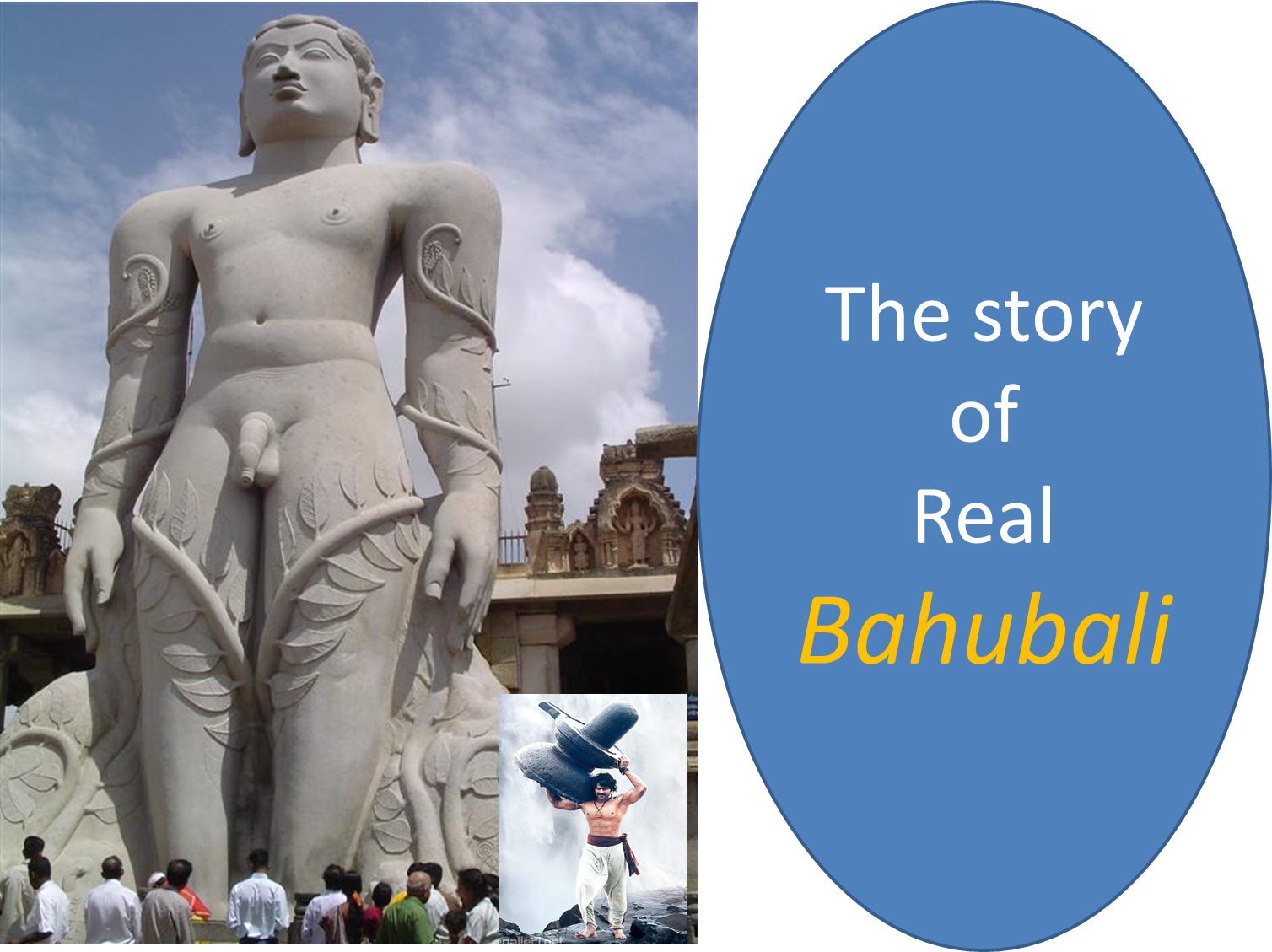
The story of real Bahubali!

The just bygone year 2017, was the year of filmi Bahubali.  But the year 2018 is the year of real Bahubali, whose mammoth 57-feet statue can be seen above.  Bahubali, also called Gomateshwara, is a digambara Jain Saint. His statue, one of the largest statues in the world was carved out of a single rock (and hence called monolithic statue) on
Vindhyagiri hill of Shravanabelagola (Hassan Dt), about 158 kms to the west of Bengaluru in Karnataka. Bhagwan Bahubali's statue on the hill can be seen from even a distance of 25 kms all around. 

Shravanabelagola is in news now, because the most awaited Jain religious event, Mahamastabhisheka of Saint Bahubali, which happens only once 12 years is being held from 17th to 25th of Feb 2018.

The year was 1967 and I was only a 11 years old boy.  I had gone to this place (just 50 kms from my native place Hassan) for this great event along with my elder sister. Although I was too young, I was amazed to  see the gathering of huge number of people from all over the country.  Besides it was delightful to watch 57-feet Bahubali statue soaked with 'abhishekam' of large volumes of holy milk, curds, ghee, turmeric, chandan amidst the chanting of devotional prayers to the Lord!

I had asked my sister then......who is Bahubali?  why this Mahamastakabhishekam? why only once in 12 years? My sister who was a teacher too by profession had told me the story on top of the hill itself.

Bahubali and Bharata were the sons of the Jain King Rishabhanatha who later on became the first thirthankara of the Jain religion. Later Bharata became the King of Ayodhya, whereas Bahubali became the King of Paudanapura in deep South.  Ambitious Bharata started conquering all Kings around and annexed his Kingdom by leaps and bounds. His 'digvijaya chakra' rolled all over without any inhibitions. But it got struck at the main entrance of his Kingdom 
itself!  Priests reminded him that he is yet to conquer his own brother Bahubali.  Bahubali, a born fighter, gifted with super-strong arms offered one-to-one fight in the form of dhristi-yuddha, jala-yuddha and finally malla-yuddha.  In all the three events Bahubali emerged victorious.  But he was pained by the violence and killings of war and felt like renouncing worldly pleasures! He gave away all his Kingdom to his younger brother Bharata.  Bahubali became a digambara sanyasi  and stood in 'tapas' for one year seeking 'moksha'.  He was so deep in tapas that all over his limbs creepers coiled and ant-hills grew around his feet! Finally he attained 'moksha' and became a revered Jain Saint. The statue of Bahubali reflects the mood of his deep tapas.

During 10th Century, it was the rule of 'Ganga dynasty' in the South.  Chavundaraya, the commander of Gangas who was a jain by religion got the 57-feet statue of Saint Bahubali carved in his town Shravanabelagola during the year 981 A.D. Mahashilpi Aristanemi is said to be the sculptor who carved this statue of Bahubali in a single rock. (Thus the 85th Mahamastakabhisheka which was held during 1981 marked '1000 years' for the world famous statue of Bahubali).

Priests advised Chavundaraya to conduct the Mahamastabhisheka for the mammoth statue befitting its size and the tradition started. Since then this religious event is being held once in twelve years. The ensuing event is said to be the 88th one.  

Swasti Shri Charukeerthi Bhattarakka Swamiji of Shravanabelagola Jain Math is the man behind these celebrations.  With the active support of State and Central Governments, elaborate arrangements are being made for grand celebration of the event.  More than 10 lakh jain piligrims, other devotees and tourists from all over India and the world are expected to take part.


I appeal to you all to mark your days for attending this great event. You can also include the nearby,  equally ancient, world 
famous Belur (above) and Halebeedu (below) temples in your program. 


In a single day return-trip, one can cover all the three places from Bengaluru.

Let me conclude with a couple of stories connected with Mahamastabhisheka event.  Chavundaraya, who was the first to conduct the event

during 981 AD faced acute shortage of milk.  Therefore he sent a 'dangura' (order by beat of drums) among his people to contribute a tumbler of milk from every household for the event.  As it was the local kings order, every family head came forward with a tumbler of milk. They all stood in the queue to pour the milk into the big vessel kept at a central place.  Only one citizen stood with a tumbler of 'water' , as he wanted to save milk for himself and he had thought that it won't make any difference when every one is contributing milk. Next day when the chieftain checked the vast vessel, he was surprised to see that the entire vessel was only water, not milk!  Obviously all people had thought on similar lines, and in order to save milk for themselves, had only poured water silently!  The message is loud and clear.  In any big event in our organization, we all have to contribute our mite without fail.  We should not fail in our duty,  hoping that all others will do the needful. Little drops of water  make a mighty ocean!


The picture above is the statue of the the deity Kushmandini devi  on the Bahubali hill in Shravanabelagola.  She had come to the first ever Mahamastakabhisheka as Gullakayajji (an old woman) with a small bowl of milk as her contribution, to test the local chief.  Dwarapalakas refused to accept her milk and she was sent out. At that time success probably had gone to the head of Chavundaraya and he was beaming with pride of accomplishing the historic task. When Chavundaraya performed abhishekam with all his huge volume of collected milk, the sacred statue could not be soaked beyond the thigh portion.  Worried leader consulted his priests, who told him about the insult meted out to Gullakayajji.  Chavundaraya with all humility searched the old lady and did the abhishekam with her bowl of milk.  The chieftain and all devotees gathered were dumb-stuck to witness that with that small bowel of milk, mammoth statue of Bahubali and even the entire hill were soaked with milk!  This incident reminds us not to ignore the contributions made by small people at the lower level.  Irrespective of great achievements, one should remain thankful and humble to one and all. I humbly thank my colleague and the learned Professor Shri. Keshava murthy for reminding me about the story of Gullakayajji, but for which my blog would have been incomplete.


-0-0-0-

Thank you for reading my blog.  Your valuable feedback may be given here itself as follows.

1.Type your comments in the box and provide your name, e mail id and mob no. in the box itself.
2.Go to 'comment as' and choose 'google account' if you have a      g mail account. It will ask for your e mail id and password.  Provide the same and your comments will be published immediately with your name.
3.If you don't have a g mail account, please choose 'anonymous' option.  It will ask you to click inside the box besides a 'captcha' and you may have to enter the 'letters and numbers' displayed as 'captcha'.  On clicking and entering your comments will be published.  If you opt for this never forget to give your name, e mail id and mob no along with your comments itself.

Alternatively you can mail your feedback to me as follows.
1.My e mail id..... klakshminarayana1956@rediffmail.com

2.Mobile No. 98455 62603 (and also whatsapp number)

3.You can also reach me on facebook at 'lakshminarayana krishnappa'


Wednesday, 20 December 2017

Uttara Kanda

Uttara Kanda
Sita looks back at her life with Lord Rama!


Early this year (2017), I was one of the eager purchasers of the latest novel  'Uttara Kanda', written by Shri S.L.Bhyrappa.  This novel has disrupted the minds of connoisseurs of the literary world.  Although the novel is a rewritten work on Valmiki’s Ramayan, much is being discussed about the treatment given to various characters and events in the holy epic  I have now chosen to humbly share with you my thoughts on the novel on the eve of 'Santheshivara Meet*' scheduled on 30th Dec 2017.

(*Santheshivara, a tiny village near Channarayapatna, Hassan District (about 170 kms. from Bengaluru)  is the birth place of Shri S.L.Bhyrappa.  Readers and patrons of the great novelist have arranged for a 'meet' at Santheshivara on Saturday, the 30th Dec 2017.  This will be a great occasion for we patrons to meet and interact with Bhyrappaji himself.  Those who are interested in attending the meet may write an e mail to 'santheshivarameet@gmail.com' to register their names and know the details).


Santheshivara Linganniah Bhyrappa (83), a Kannada novelist is a living legend. He has authored 31 novels which are household names not only in Karnataka, but also all over the country and the world. Almost all his novels are translated to many Indian languages and also English.  Forty years ago when he rewrote ‘Mahabharath’ as ‘Parva’ (translated to Samskrut, Telugu, Marathi, Bengali, Hindi, Tamil, Punjabi and English), it was an eye opener for ‘free thinkers’.  Mahabharath was depicted not as a work of mythology but as an event of history. All major characters including ‘Lord Krishna’ were just men ‘fallible to human temptations’ for Bhyrappaji.  Present novel ‘Uttara Kanda’ is a similar work describing Ramayan and its characters  from Sita’s perspective. Sita is never a passive woman here and she dares questioning Ram and treads her own path. Moreover no miracles here, every event is a real one.  Entire novel is presented as a flash back by reminiscent Sita during ‘Uttara Kanda’.  

It was ‘Ashok Van’ in Ravan’s Lanka.  Expectant Sita became jubilant on hearing Rama’s victory and the killing of Ravan.  Soon came Sarame, the wife of Vibhishan asking Sita to dress up for being taken to meet her victorious husband Ram.  Wearing the choicest jewels gifted to her by Mata Anasuya, eager Sita comes to the battle ground to meet her ‘Prabhu Ram’ whom she was missing for over one year. All were excited including Sita, but not Lord Ram!  There was eerie silence all over.


‘Janaka Putri’………….Ram addresses Sita to break silence……‘I have fought this war and killed Ravan not for you, but to uphold the glory of my Ikshwaku dynasty!  There ends my task.  You were in the custody of rakshas Ravan for so long. I don’t believe in your chastity. I don’t like to accept you back. You are free to go anywhere’.  It took some time for Sita to withstand the shock of thundering words of Ram, but recovered to shot back at him. ‘Ram…..my father got me married to you hoping that you are a noble man.  How can such distrustful thoughts come to your mind to reject me’?


It was turn of Laxman to intervene and prevent Sita from getting in to the fire.  Laxman took Sita’s cause and fired at Ram. ‘Supposing Sita too questions your chastity during her absence, what answer you can give? Accept Sita and move on.’ 


Under forced retreat at Valmiki’s Ashram, ripe pregnant Sita took a stroll at the turn of events during those days.  Her mind probed…….’Is Ram harsher than Ravan? Whether it was the same Ram who took up the cause of immoral  Ahalya and reunited her with Saint Gautam’? ........ Yes it was a decades old story…………….Ahalya, the young and beautiful wife of Saint Gautam had to live a ‘dry’ life.  Frail bodied Gautam always used to be in ‘tapas’.  Naturally Ahalya was tempted towards the seducing King who used to visit the ashram.  When the ongoing event came to Guatam’s notice, he became furious.  He told  her illicit acts to all in the neighbourhood and went away to distant Himalayas for doing ‘deep tapas’.  Shamed Ahalya confined herself inside the Ashram for days together.  When neighbours knocked at her door, she threatened to hang herself.  Neighbours gave up, but started keeping food and water at her doors everyday.  Ahalya started living this way, but continued to confine herself inside and was virtually cut off from the rest of the world for years together.


When Saint Vishwamitra along with young Ram and Laxman came to meet Gautam at his ashram, they came to know about the ‘self-imposed exile’ of Ahalya.  Inspired by Vishwamitra, Ram took initiative to bring out Ahalya and reunite her with Saint Gautam.


‘Why this judgment of double standard by Ram?  How can he be so kind to errant Ahalya and be so cruel to me, who lived only for him and nobody else’?.............Sita’s stream of sorrowful thoughts continues.  And while sending her away from Ayodhya,  Ram not even bothered to tell her the facts. Under the pretext of sending her to offer ‘pujas to Rishipatnis’, Ram sent away pregnant Sita to Valmiki’s ashram along with Laxman.  While leaving her,  Ram’s agent Laxman just mentioned that ‘Maharaj’ has divorced her and went away!


What made Ram to conduct himself so curtly against Sita, not on one, but two occasions?  Did Ram become power conscious and too scared about public opinion?  Did ‘maryada purushotham Ram’ lost to ‘Maharaj Ram’?  Did he not err in his roles as a dear husband and an expectant father? Could he have chosen to give up power to uphold  family life and human values?  Let us leave this to Sita's judgment.

Now it was the turn of Saint Valmiki to take up Sita's cause.  He brings her along with Lav and Kush to Ram's court to work out a reunion on the occasion of 'ashwamed yag'. Valmiki's sane words were an eye opener to the  entire court and Ram too.  Relenting Ram invites Sita to join him.  But  now Sita becomes assertive and speaks rising her voice........'this reunion initiative came from Saint Valimiki, not from you Ram.  Not even once you thought about me during these sixteen years of my 'vanavas'.  Had you called also, I wouldn't have come.  I am a daughter of the soil and I prefer to go back to Valmiki's ashram to continue farming.  Farming for me is the best way to reunite with my 'boo-mata' and walks away.  And the entire court becomes dumbstruck! Ram's desperate shouts......'Sita, Sita please come back' goes in vain! Helpless Saint Valmiki laments.........'I could only write Ramayan, but couldn't influence its tragic end'!


Now let me humbly try to place before you all my views about the novel.


I would like to have a look at the Ahalya incident in the novel.  Bhyrappaji has tried to give the most probable and realistic description of the miracle of Ahalya turning a 'rock' due to Saint Gautam's curse. Shamed by the exposure of her affairs with the visiting King, Ahalya confines herself alone to her Ashram for years together, while Gautama goes away for doing 'tapas'.  When young Rama visits Gautam's ashram along with Saint Viswamitra, he takes up Ahalya's cause and succeeds in bringing her out.  Also Rama mediates the issue with Saint Gautama himself and brings about a reunion of the senior couple.  This looks unrealistic.  Was not Rama too young to play the role of a mediator for this event?  Moreover at that time Rama himself was not even married.  How could Bhyrappaji discount the presence of the most experienced and the versatile Saint Vishwamitra who had also a stint of romance and family life with the proverbial beauty and dancer 'Menaka'?   Obviously this task of bringing out Ahalya from the shell and working out her rapprochement with Saint Gautama must have been the deft task handled by Saint Viswamitra!  May be  Saint Viswamitra might have given the credit to young prince Rama.  This could have been a more logical sequence of roles and events to bring the whole incident into the realms of reality.


Hinduism is probably  the most tolerant religion in the world. Unlike a few other major religions of the world, Hindus are never aggressive and they have never invaded or fought any other country,  except for self-defense. The fact that India is the only homeland for Hindus is a testimony to our peaceful and non-aggressive nature. 'Free thinking' is in our blood and that is why India has assimilated and accommodated other religions and thoughts of the world.  Obviously our readers have wholeheartedly welcomed Bhyrappaji's 'Uttara Kanda' and its critical approach to the great epic.


But Lord Rama is the most revered God for majority of our people.  Even the most learned Saint Valmiki has described Lord Rama as the 'maryada purushottam'!  Of course even among us there are many who are questioning Lord Rama's ways and actions!  Whether Lord Rama was a God or one more fallible human being is a never ending debate.  Believers may dare Byrappaji to write similar critical novels about Gods of other religions too!  Byrappaji has shown greater courage and freedom of thought while writing his earlier controversial novel 'Aavarana (2007)'. In that most discussed novel, Bhyrappaji has never minced words in exposing the evil practices and beliefs prevalent in the Islamic religion.

Of course the debate goes on.  'For those who believe no proof is necessary, and for those who do not believe no proof is enough' can only be the most acceptable statement about Lord Rama. Let noble thoughts come from all sides. Free thinking and tolerance shall become the guiding spirits of our way of life. But I would like to add a word of warning.  Free thinking shall never become a tool for the policy of selective appeasement!  And I am sure our great writers like Byrappaji will show us the way!


                                                                    -0-0-0-0-0-0-0-0-0-0-0-0-

Thank you for reading my blog.  Your valuable feedback may be given here itself as follows.
1.Type your comments in the box and provide your name, e mail id and mob no. in the box itself.
2.Go to 'comment as' and choose 'google account' if you have a      g mail account. It will ask for your e mail id and password.  Provide the same and your comments will be published immediately with your name.
3.If you don't have a g mail account, please choose 'anonymous' option.  It will ask you to click inside the box besides a 'captcha' and you may have to enter the 'letters and numbers' displayed as 'captcha'.  On clicking and entering your comments will be published.  If you opt for this never forget to give your name, e mail id and mob no along with your comments itself.

Alternatively you can mail your feedback to me as follows.
1.My e mail id..... klakshminarayana1956@rediffmail.com

2.Mobile No. 98455 62603 (and also whatsapp number)

3.You can also reach me on facebook at 'lakshminarayana krishnappa'


Saturday, 2 December 2017

Chandramukhi - Jwalamukhi

I am seen in this picture taken at Bali islands, Indonesia during  Nov 2015.  Of course I am with my dear wife 'chandramukhi -Anasuya' and also 'jwalamukhi - Mt Agung', and fortunately both of them are in pleasant moods here! Volcano Mt Agung can be seen here with its blunted top, called the 'crater' which has occurred due to earlier eruptions.
But last week the sleepy Mt Agung has caused grave concerns. After a gap of 54 years the volcano has started fuming causing panic among people! Indonesian Government has raised high alert.  Massive columns of thick grey smoke have erupted shooting to a height of  3 kms into the sky, forcing flights to be grounded! About a lakh of inhabitants living around are evacuated to distant places.

During last two days there is a lull in the volcanic activity causing some uneasy calm in the island.  But volcanologists fear that at any time there may be deadly eruptions which may cause huge damages. These developments have caused a massive hit to the tourism activity of the island, which forms the main source of income for almost all inhabitants.


Volcanoes are just a natural way that the mother earth and other planets cool off their internal heat and pressure. As can be seen in the picture, volcanoes have access to the magma (molten rock) present deep inside the earth.  Collision between surrounding rocks and magma, causes magma to rise building a sort of pressure over a period of time.  This causes formation of bubbles due to release of gases dissolved in magma resulting in further rise of pressure. The pressure helps magma to rise to the surface, which we call as the volcanic eruption!  This process is almost similar to soda water gushing out when the bottle is opened.


World has witnessed innumerable number of such volcanic eruptions since its formation.  The worst three eruptions recorded so far are as follows.

1.Mt Tambura, Sumbawa Island, Indonesia erupted during 1815
causing massive killings and damages.

2.Mt Krakatoa, in islands of Java and Sumatra, Indonesia erupted during 1833, killing 35,000 people and causing Tsunamis!

3.Mt. Pelee in the Carribean island erupted during 1902, killing about 30,000 people.


Well, in our own country India, there is only one active volcano (seen in the pic above) situated in Andaman and Nicobar islands.  It had shown some activity during 1991.


We all call our dear life partners as chandramukhis.  But they too can erupt like jwalamukhis.  Like jwalamukhis they will be calm and quiet for long and they may not erupt due to small disturbances.  But these small disturbances may be boiling inside and it only needs a threshold providing trigger to erupt. We all remain complacent and don't notice the pressure building inside. And on one bad day,  we foolishly provide the trigger and that is when our chandramukhis become jwalamukhis!  The effect would be equally devastating on us and it takes long for them to calm down.  


Even in our society also we often witness volcanic type of eruptions in the form of communal riots. It is difficult to pin-point the blame on a single group.  All sections are capable of building pressure and it only requires a small trigger for the riot to erupt.  And when it erupts, it takes long to subside, but will subside only after taking its toll!


Conflicts and cold wars between countries can be much more devastating when compared to volcanic eruptions.  We have already witnessed two world wars (1914-18 & 1939-45) of which the second world war was a nuclear war too.  Since then many conflicts have almost come to the threshold of a world war, but thank God, somehow they have subsided.  Even today no one can rule out the possibility of a third world war and if it happens will the mankind survive?  
Let me conclude by quoting the greatest philosopher and the scientist of our times, Albert Einstein who said......


                    I know not with what weapons
                    world war III will be fought,
                    but world war IV will be 
                    fought with sticks and stones! 

(Of course some say, this statement is allegedly attributed to him.  But nobody can remain blind towards the blunt truth in this statement). I leave it to your imagination to interpret why the great man has said like this.  I am sure you will explain the same to me while giving your feedback.
                                                              -0-0-0-0-0-0-0-0-

Thank you for reading my blog.  Your valuable feedback may be given here itself as follows.
1.Type your comments in the box and provide your name, e mail id and mob no. in the box itself.
2.Go to 'comment as' and choose 'google account' if you have a      g mail account. It will ask for your e mail id and password.  Provide the same and your comments will be published immediately with your name.
3.If you don't have a g mail account, please choose 'anonymous' option.  It will ask you to click inside the box besides a 'captcha' and you may have to enter the 'letters and numbers' displayed as 'captcha'.  On clicking and entering your comments will be published.  If you opt for this never forget to give your name, e mail id and mob no along with your comments itself.

Alternatively you can mail your feedback to me as follows.
1.My e mail id..... klakshminarayana1956@rediffmail.com

2.Mobile No. 98455 62603 (and also whatsapp number)

3.You can also reach me on facebook at 'lakshminarayana krishnappa'


Saturday, 18 November 2017

Indira Gandhi - 100

The year was 1966 and I was just a 10 years old boy.  My beloved Social studies teacher, Narayana Achar, who kindled my interest in politics was in the classroom.  That was the day when the next Prime Minister of India had to be chosen.  Our teacher had told that the choice should be Morarji Desai, as he was more experienced.  But it turned out to be otherwise.  The then inexperienced Indira Gandhi won the contest with the support of Congress veterans and became the first woman Prime Minister of our country.  And since then I had the privilege of following her ups and downs with keen interest.

Not much happened during 1966-67.  Indira who was described as 'goongi gudiya' (meaning dumb doll) those days by some seniors took her time to settle in.  She managed to comfortably win the 1967 general elections and rode back to power.  This gave her the confidence to start asserting herself.


She nationalized 14 major banks during 1969,  which proved to be a revolutionary step later on.  This paved way for fast growth of banking network throughout the country, especially in semi-urban and rural sectors.  The concept of 'class banking' gave way to 'mass banking' which made the banking services, especially the loans for agriculture, small industries and business (also called priority sector) available even to the poor.  This banking revolution provided jobs to many youngsters like me throughout the country.


Indira now beaming with new confidence took another bold step!  She abolished the privy purses (pension) being given to erstwhile Kings. This was a step which reduced the 'dynasty status of former kings' to that of ordinary citizens of democratic India.  The irony is that the same Indira Gandhi was accused later of promoting  'dynastic rule' by imposing her own family on our country.

Assertive Indira started side lining veterans like Morarji Desai (left above).  Her assertion was total when she installed her own personal choice as the President of India defeating the official candidate of the Congress party.  This led to the split of Congress party itself and the result.....Indira Gandhi emerged stronger.


During 1971, Indira Gandhi swept the polls and won a massive majority with the election slogan 'garibi hatao'.  I remember those days when I along with my friend had waited till late midnight to listen to her election speech in my native place Hassan.

Soon she was confronted with the problem of lakhs of refugees entering India from the neighbouring East Pakistan (now Bangladesh).  Indira Gandhi seized the opportunity to wage a legitimate war against Pakistan.  She displayed great bravery and courage during the war.  

India won the war within just 14 days and Pakistan surrendered paving way for the birth of a new country, Bangladesh.  Many historians describe this as the greatest moment in the life of Indira Gandhi. Many in the country during those days, described Indira as the incarnation of 'Maa Durga'.  'Maa Durga' comparison was so much heard those days that many believe even today that it was first uttered by Mr. Vajpayee in the Parliament. But as denied by Mr. Vajpayee himself later, it was all a rumour.

Riding on the success of her war victory, Indira Gandhi encouraged her nuclear scientists to perform 'nuclear test'. Full credits to her leadership in getting us the status of a nuclear power in the world.

Soon Indira Gandhi became the undisputed leader of her Government and the party.  R.K.Laxman's cartoon above rightly depicts her 'super PM status' she commanded during those days.

As per Newton's Law anything that goes up must come down.  This probably caught up with Indira Gandhi too, when she signed the 

Simla Agreement (1972) with Pakistan later.  With this Pakistan got released all its 90,000 prisoners of war.  Many historians say that Indira Gandhi could have bargained better for resolution of Kashmir issue then itself.

In between a banking fraud amounting to about 60 lakhs of rupees (which was a huge sum then) occurred in State Bank of India which was then famous as the Nagarawala case.  The Nagarawala mystery was never solved!  Many say that corruption and frauds grew their roots strongly during Indira Gandhi's regime.

1973-75 were turbulent years for Indira Gandhi.  Indira's autocratic nature made her unpopular among the then opposition leaders. Moreover inflation, price-rise and Oil crisis haunted the country.  Opposition leaders led by Jayprakash Narayan mobilized people against Indira Gandhi under 'sampooran kranthi' banner.  The climax of all these developments was when Indira Gandhi was unseated from her Parliamentary Seat owing to electoral malpractices as per a verdict of the Allahabad High Court (1975).

In order to manoeuvre all these complications Indira Gandhi declared 'emergency' which is now famous as the black period in the history of democratic India. 

The above cartoon which caught the attention of the entire country then described the meekness with which the then President Fakruddin Ali Ahmed (in the cartoon here) signed the 'emergency' orders. Her son Sanjay Gandhi's activities during emergency too created a bad opinion in the minds of people.

All these developments led to the fall of Indira Gandhi during the 1977 General elections.  Many major opposition parties merged themselves to form the Janata Party which emerged victorious.  Historians described the Janata Party as the conglomeration of heterogeneous forces and they can't hold on for long.  This proved right when the Janata Government fell during 1979 itself.

Indira Gandhi stormed back to power during 1980.  It began disastrously for Mrs. Gandhi when her son Sanjay Gandhi was killed in a plane accident.  This made Indira Gandhi to bring her other son Rajiv Gandhi to politics.

Indira Gandhi proved to be a great sports patron when she successfully organized the 1982 Asian Games in India.  This revolutionized the sports enthusiasm in the country and led to development of sports infra of international standards. To her credit I must say that a sports event of that magnitude has never happened in India since then!

World cup cricket victory during 1983 was one more high during Indira Gandhi's regime.  She lauded the winning team which later led to emergence of India as the world leader in cricket.

The year 1984 proved disastrous for Indira Gandhi.  Sikh militants were playing havoc in Punjab under the banner of 'Khalistan Liberation Movement'.  Foreign forces were actively aiding this dubious cause.  Quirk of irony had made Sant Jarnail Singh Bhindrawale (inset in pic below) as the super militant leader, who once was said to have been patronised by Indira Gandhi herself for countering Akali dal forces in Punjab.

To bring out militant forces from the sacred seat of Sikhs, Golden Temple, Amritsar, Indira Gandhi had to order military action under the code name 'operation blue star'. 

I served in Punjab during 1980-85 and was a mute witness to the entire militant movement.  Although 'operation blue star' was successful in eliminating militants from the Golden temple, it caused a deep hurt in the minds of the entire Sikh community.

As a result Indira Gandhi was shot dead by her own sikh security men in her own residence in Delhi.  Thus a glorious chapter in the history of independent India saw a tragic end.

Indira Gandhi as a leader was loved and hated by turns.  Her contribution to poverty alleviation is unquestioned.  Similarly it was during her regime that India achieved self-sufficiency in food production.  Her courage saw India emerge as a nuclear power.  With her brave leadership, she could humble and dismember Pakistan by separating Bangladesh. Rightly she was rewarded the Bharat Ratna during 1971 itself.

Probably her economics was weak.  She never thought of introducing 'economic reforms'.  She went on nourishing public sectors like her father which proved to be 'not enough' in the long run.  Had she ushered in economic reforms in India during 1970s itself, India too could have grown faster like China. Of course, one may say, speaking in the hindsight is easier!

Even today millions of Indians remember her words she spoke during the penultimate day of her life in a public speech in Odisha.  'If I die today, every drop of my blood will invigorate the nation'.

Long live the memory of Indira Gandhi

Long live India.

-0-0-0-0-0-0-0-

Thank you for patiently reading my blog.  You may please give me your feedback here itself.  Also you can mail me at klakshminarayana1956@rediffmail.com

You may also reach me on facebook at 'Lakshminarayana Krishnappa' or Mobile 98455 62603

Saturday, 4 November 2017

One Year of Demonetization


Nov 8th, 2017 marks the 1st anniversary of the now controversial demonetization.  While some have heralded demonetization as the first ever massive war against black money in our country, our opposition parties have described it as a 'monumental blunder' which has killed almost all small businesses.

Prime Minister Modiji's sudden announcement of demonetization on that most remembered night of Nov 8th, 2016 took the entire country by shock. It was described as a surgical strike on black money by the ruling party.  Even the opposition parties went on back foot before recovering from the shock.  As the events unfolded it was full of confusion and hardship for the common man.

  • People stood in the mile long queues in front of Banks and ATMs to exchange their money.
  • People were irritated by the small limits fixed per exchange.
  • Moreover people witnessed cashless Banks and ATMs on most of the occasions.
  • Many deaths were reported in those serpentine queues.  Although all those deaths could not be attributed to the queue hardships, opposition parties were quick to take advantage. At least one pregnant lady delivered a girl child (named 'Kazana') while being in the queue. 
  • People suffered without enough cash for marriages, medical treatments and funerals.
  • Anti-social elements took advantage by exchanging crores of money for hefty commission much to the disappointment of common men.
  • Small businesses and daily earners like rickshaw-operators had the worst hit of substantial business losses.
  • Cash based MSMEs like leather industries and construction sector too registered worst shocks.
  • Real estate witnessed the worst slump.
Soon the opposition parties lead by Congress, economic experts and even some intellectuals became most aggressive critics of the entire process. Even the Government became scared and did many panic acts.
  • Government made innumerable changes in the money exchange rules.
  • Planes/Helicopters and even military was pressed in to service in order to ensure supply of currency all over country.
  • Even the P.M. himself came once again on T.V. and requested people to bear with the hardship for 50 days after which he promised that the things would return to normal. Also P.M. claimed that 3-5 lakh crores of black money will not come back resulting in bounty for the Government which will be used for welfare schemes of people.
Majority of our people showed exemplary patience.  They believed that the war against black money is really on and their hardship will not go waste.  But opposition parties continued to attack the Government relentlessly.

As further drama unfolded, RBI confirmed that  99% of the Rs.15.4 lakh crores of currency have been exchanged by people.  Opposition parties described the entire exercise as disastrous.  It was further alleged that all black money holders and big people have never suffered  and they have conveniently exchanged all their ill-gotten wealth. 

Looking back, demonetization is certainly not without gains for our Country.
  • Yes, it is our Country's first ever massive and honest war against black money. It was never done for gaining  monetary or political gains for the ruling party
  • It has neutralized our enemy country's machinery which was allegedly printing  fake currency to spoil our economy.
  • Money with terrorists and anti-socials also stood substantially neutralized. This is evidenced by notable improvement in Jammu & Kashmir situation.
  • As per RBI report entire black money is now deposited with banks which is a welcome process. Huge deposits in many accounts are under IT investigation. This has also made our banks cash rich resulting in reducing of lending rates.
  • Demonetization has certainly created fear element in the minds of black money holders.  This is well supported by the fact that the number of those who are filing IT returns has registered a substantial increase since 8th November 2016.  
  • Demonetization has given a great boost to the process of 'digitization' of the country's economy.  There is substantial increase in digital transactions.  Number of Bank ATMs has registered a small decrease too.
  • Many rich people have probably exchanged  money through their poorer conduits.  This has resulted in some money in to the hands of poor people.  A sort of social justice indeed!
  • Loss of business and hardship to people seem to be exaggerated.  This is supported by the fact that Rabi sowing during Nov-Dec 2016  witnessed notable increase.  Remember sowing operations are predominantly cash based.
  • Real estate prices in the country have come down considerably as the role of black money has seen a dip.  Sales seem to be picking up now in the recent quarters.
  • In my personal view, coming back of 99% of estimated currency is unbelievable.  Even big black money holders may not want to exchange 99% for fear of being caught. Also the seizure of high volumes of old notes subsequent to demo also is surprising. This gives rise to a thought that there might have been more physical currency than estimated.  If so, even all that amount of black money now stands neutralized.
Our people have taken the hardship of demonetization in their stride.  This was amply substantiated by the fact that people gave a massive mandate to the ruling party in the U.P. assembly elections that followed.
Nobel award winner for Economics - 2017, Robert Thaler has hailed demonetization in India as a brave fight against black money. Even former RBI Governor Mr.Raghuram Rajan who has acknowledged that he too was kept in the loop before, has conceded that it takes some more time to count the benefits of demonetization.  In cricketing terms, some experts have termed that demonetization is not like T-20, but it is more like Test cricket and calls for patience.

In the hindsight it may be easy to analyse wisely.  But demo had its own challenges of keeping utmost secrecy.  Obviously Government could not plan it well.  But the same benefit of doubt can not be given to the Government in the matter of GST implementation.  It was well known to the


Government that implementation of GST is a problematic exercise.  More than 150 countries have rolled out GST  already and all those countries have witnessed first year problems.  In a few countries the Governments who implemented GST have even lost the immediate next elections.  Therefore Government should have been careful while giving effect.

Present GST is said to be complicated with 4 different slabs.  Moreover the registration, filing of returns and seeking refunds too seem to be complicated, especially for small businessmen.  Also the faulty GST Network designed by the vendor (said to be Infosys) has also not helped.

It could have been implemented in phases after taking in to consideration the interest of small businesses.  Further the rate of GDP growth falling down to 5.7%  for the latest quarter has left the ruling party itself red-faced. Once again Government is forced to make a series of amends and the business world and the opposition are shouting not enough.

Congress leader Mr. Rahul Gandhi has even termed GST as Gabbar Singh Tax. Gabbar Singh is the


ferocious villain from the mega hit film 'Sholay' which was released during 15th August 1975. A couple of months earlier, i.e. on 25th June 1975, the then Congress Prime Minister Smt.Indira Gandhi had imposed 'emergency' in the country which is now remembered as a 'black period' in the history of Indian democracy.  Those were the days when Income Tax was as high as 95% and since then our country has witnessed many reforms.

Coming back to Gabbar Singh and  Sholay, during initial days of release the film was not received well.  It took about two weeks for the film to pick up the tempo.  Even in case of GST, it may become true. Although the initial reactions are adverse, GST may turn out to be a blockbuster event  in our country's economic history.

However our country has received a shot in the arm last week.  World bank in its report has


rated India at '100' in the ladder of ease of doing business, giving us the huge jump of '30 places' which is the highest ever.  This is the result of a series of reforms including GST,  that the Government has implemented during last 3 years as follows.
  • Insolvency Act
  • Real Estate (Regulation and Development) Act - RERA
  • Massive Pradhan Mantri Fasal Bima Yojna
  • Direct benefit transfers
  • Substantial increase in FDI in Insurance, Defense, Railways, Construction, multi-brand retail and e commerce
  • Transparency in Coal and Telecom auctions
  • One stop clearance for new businesses
  • Bank mergers
  • Demonetization
  • G.S.T.
Lastly both demonetization and GST are ambitious economic reforms of the present Government.  Both of them were known risky steps. GST process is now irreversible and has come to stay.  Our Prime Minister Mr. Narendra Modiji has shown vision and boldness in taking these historic steps.  To the credit of our Prime Minister it must be said that it was never initiated for gaining monetary or political benefits for self or the ruling party. Let us hope that the system of GST settles down well, bringing all the desired benefits to our people.

-0-0-0-0-0-0-0-0-0-0-0-0-0-

Thanks for reading.  Please give your feedback here itself.  As an alternative you can mail your feedback to klakshminarayana1956@rediffmail.com.  (Mobile 98455 62603)