Saturday, 28 April 2018

Flowering trees

Once Lord Krishna visited Indra Loka along with his dear wife Satyabhama.  There Satyabhama was attracted by the Parijata flowering tree and loved to take it to her Kingdom Dwaraka.  When Krishna and Satyabhama started taking the tree to their motherland, Indra objected.  Furious battle erupted and ultimately Lord Krishna had to use his Sudarshana Chakra to defeat Indra.  Humbled Indra had no way and had to let the beautiful tree to be taken to Bhuloka, the earth! This well known story called 'Sri Krishna Parijata' is a popular theme for Indian poetry, music, dance and drama.

But this legendary effort of Lord Krishna was just one more addition to the host of flowering trees already on this earth. Right now we are in the midst of spring season (March-May).  Entire world is beautified by the glory of flowering trees which are in their full bloom!  It is a pleasure to watch them while walking and travelling. Often we fumble to identify their names and origins and hence this humble effort of mine.

1.Parijata 
Common name: Night Flowering Jasmine
Origin: Indian Sub-continent
Flowering season: March-April
Local Name: Parijata in most Indian languages

During morning walks, we find these paritaja trees on roads and parks.  Often we feel like bending down to pick these white petaled-orange stemmed flowers lying down.  Some even just shake the branches of these trees when it falls down in large numbers. People pick them for performing morning pooja.                               
2.Golden shower
Common name: Golden shower
Origin: Mountains of Southern Europe
Flowering season: April-June
Local name: Laburnum, Amalthas in Hindi, Haldi Hoo in Kannada
This late flowering tree blossoms when most other trees are past their bloom and hence it ensures a sort of extended spring. Stem of this tree is quite strong and used in making agricultural equipments.

3.Flame tree (May Flower)
Common name: Flame Tree OR Mayflower
Origin: Madagascar
Flowering season: April-May
Local name: Palash in Hindi, Gulmohar in many Indian languages, Gentige Hoo in Kannada

This beautiful tree is fast growing and hence brittle.  Most of the city corporations have found this tree falling during heavy rains disturbing the traffic.  Many Corporations are now avoiding fresh plantings and therefore it is less seen now-a-days.
4.Garlic pear tree (Crateva)
Common name: Garlic Pear Tree
Origin: Europe
Flowering season: March-June
Local name: Barna in Hindi, Niravala in Kannada

This tree named after the great Greek naturalist and Physician Cratevas, is a medicinal tree too.

5.Bauhinia
Common name: Bauhinia
Origin: India
Flowering season: April-May, Sep-Oct
Local name: Kachnaar in Hindi, Basavana Paada in Kannada
It is a beautiful ornamental tree with a wide range of colours like purple, lavender and pink.
6.Jacaranda
Common name: Jacaranda
Origin: Brazil
Flowering season: Feb-March
Local name: Neelkanth in Hindi

Jacaranda comes in both blue and pink colours.  A treat to watch the tree when in full bloom.
7.African tulip tree
Common name: African Tulip Tree
Origin: Africa
Flowering season: August to December
Local name: Fountain Tree, Rugtoora in Hindi, Neerukai (Uchhe kai) mara in Kannada

These commonly found and strong stemmed trees are distinct with thick green leaves and large dark red flowers. Flowering lasts for longer time.  The buds of the flower are soft with water (neerukai) inside. During childhood we used to play pranks with each other by  spraying the water inside by pressing the buds.
8.Red silk cotton tree
Common name: Red Silk Cotton Tree
Origin: Asia
Flowering season: March-May
Local name: Kantisenbal in Hindi, Boorugada mara in Kannada

Stem of the tree is thick and spiked. The nut of the tree gives rise to cotton which is used for making beds. This tree is also called 'silent doctor' as its parts are used as medicine for treating many ailments.

9.Canon ball tree
Common name: Canon Bal Tree
Origin: South America & West Indies
Local name: Naaga Linga in most Indian Languages
Strangely flowers of this tree is in the trunks.  This flower is considered sacred in India as it resembles 'Shivaling' with serpent-like arch covering it!  The fruits of this tree are spherical in shape and large in size.
10.Indian beech tree
Common name: Indian Beech Tree
Origin: India, Australia & China
Flowering season: March-april
Local name: Karanja in Hindi, Honge mara in kannada
Flowers of this tree are not prominent.  The tree is known for thick green leaves and provides the most comfortable shade.  There is a proverb in kannada which says 'taayee madilu, honge neralu' meaning this tree's shadow is as comfortable as the mother's lap!  The nut of this tree is used in extracting non-edible oil which is also a medicine for body-massage. The size of this tree is modest and quite stable by constitution.  Therefore almost all municipalities/corporations are planting this tree in large numbers.
India is blessed with a wide variety of trees.  Trees spread their branches and  leaves around to attain grace, balance and beauty much beyond the imagination of the most creative artist!  Their roots go deep into the soil holding it in tact.  They clean the environment by absorbing carbon dioxide to prepare food and release the much needed oxygen for all of us.  With clock-wise precision they keep time with seasons to bear fresh leaves, flowers and fruits for benefit of all living beings.  But thankless man keeps axing them for meeting his selfish needs.  They want trees all over the city, but not one in front of their house!


Let us learn to live like trees.  Let us plant more trees, protect them and save this wonderful nature for our coming generations.
-0-0-0-0-0-0-0-


Saturday, 31 March 2018

Music Festivals of India

It's now Sri Rama Navami Music Festival season all over Southern India.  The month-long annual festival which started on 26th March 2018, has added musical charm to the onset of spring season.

The noble tradition of celebrating Sri Rama navami (Lord Rama's birthday which falls on Chaitra Shukla Navami) with classical music was initiated by none other than Krishnaraja Wodeyar, the Maharaja of Mysuru.
He was a great patron of music who nourished great musicians like Mysuru T. Chowdaiah (violin) and Mysuru Vasudevachar, the great 20th century composer who composed great kritis like Broche vaare varura.

Common men too have never lagged behind in taking the lead in celebrating Rama navami music.  Saint Tyagaraja was their inspiration who dedicated all his compositions and music for the praise of Lord Rama.
Late S.V. Narayanaswamy Rao (right-top in pic) was a humble employee of HAL who started organizing Ramanavami music at his tender age of 14!  Due to his dedicated and relentless efforts, Sri Ramanavami Music in Bengaluru today is celebrating its 80th anniversary. It has provided platform for five generations of musicians in showcasing their talent and enthralling music lovers. Noted singer Yesudas has been performing in annual Carnatic classical concerts (south Indian classical  music) here continuously for more than 50 years!

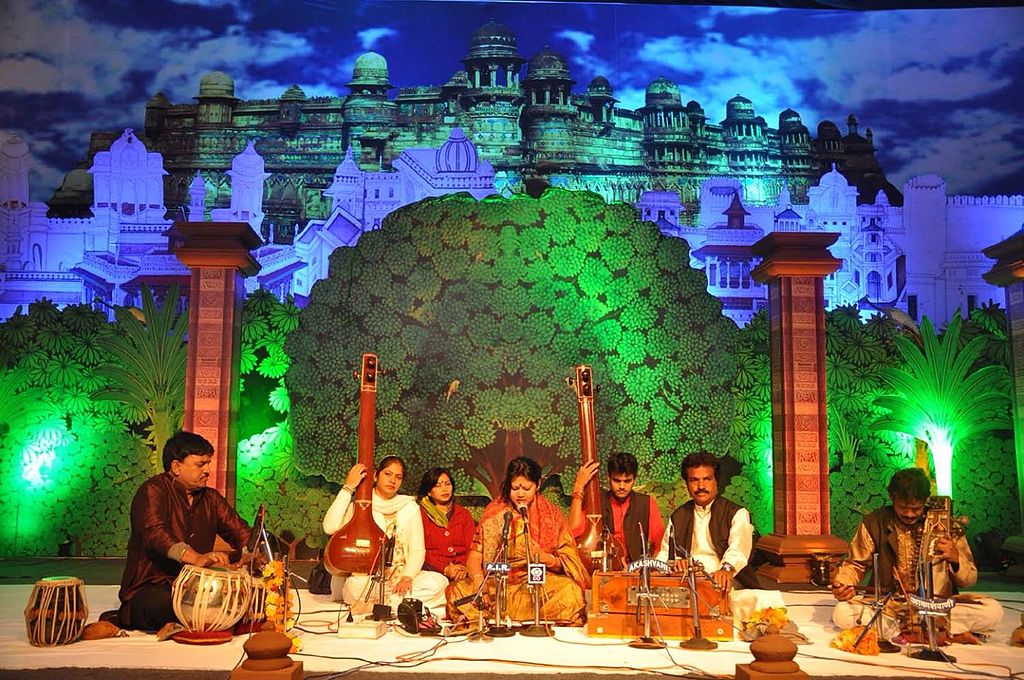
Tansen Sangeet Samroh, is celebrated every year during December, to honour the memory of Tansen (1493-1586) who was born as Ramtanu Misra.  He was a prominent Indian Classical Musician and was one of the navaratnas in the court of Akbar, the great. 
The event is being organized in Gwalior near the tomb of Tansen by Ustad Allauddin Khan Sangeet Academy and the Government of Madhya Pradesh, since 1950. The 4-day long 'national music festival' attracts prominent musicians from all over the world!

Tyagaraja Aradhana is celebrated during January, every year to pay homage to the musical saint Tyagaraja (1767-1847).
This event is held near the samadhi of Saint Tygaraja in Thiruvaiyaru, Tamil Nadu  on the banks of the river Cauvery.  Musicians and devotees  from all over the country come here, sit on either side of the samadhi and sing pancharatna kritis of the musical saint.  The event is being organized by the saint's devotees since 1905.

The Sawai Gandharva Bhimsen Mahotsav is an annual Indian music festival held during December every year in Pune since 1953.  Sawai Gandharva was the 
Guru of Bharat Ratna Bhimsen Joshi, probably the greatest vocalist from Kirana gharana.  The festival was started by Bhimsen Joshi himself in honour of his Guru. After the death of  Bhimsen Joshi (2011), the festival was renamed including his name too.

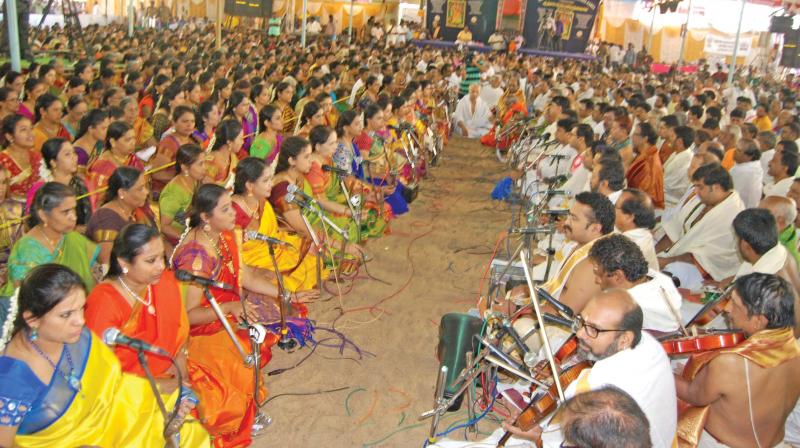
Margazhi Music Festival is held during Dec-Jan every year in Chennai.  This great tradition was  started during 1927 by a group
of music lovers, who later on established the Madras Music Academy.  This music festival is said to be the largest of its kind in the entire world.  Every year concerts from veterans and budding artists are arranged by various music Sabhas all over Chennai.  The number of such concerts during every season reportedly crosses 2000! 

Hariballabh Sangeet Sammelan is probably the oldest music 

festival in the world.  This sammelan which has a history of 143 years is celebrated during December every year in Jalandhar, Punjab to commemorate the memory of the late musical Saint Hariballabh, an exponent of Hindustani Music. This festival attracts musicians from the neighboring Pakistan too for performance.  Government of India has recognized this event as a 'National Music Festival'.

Love for classical music in our country is not just confined to major cities.  These celebrations are evenly spread all over India in its smaller towns and villages too.

India's greatest contribution to the world of culture is its classical music.  Indian classical music consists of two forms, Hindustani and the Carnatic (south Indian) music.  The hallmark of both these forms of music is their uniqueness in  presentations by way of improvisation and spontaneity. It is heartening to note that in all these major festivals, classical artists from all parts of India and even from other parts of the world are invited to perform, thereby recognizing our cultural unity.

With passage of time, love for classical music is also taking a hit.  

Our youth are carried away by the instant kick provided by film 
music and pop music!  

But the advent of younger classical artists and their popularity is 
providing the silver lining. Support from the corporate world, media and even the Governments is also helping the cause in no small measure.  Let us hope that our GeNext retains its zeal in taking this great tradition forward.


Long live our classical music!

Long live India!!
-0-0-0-0-0-0-0-0-


Thursday, 15 March 2018

World Storytelling Day

Storytelling is an art.  We all have grown up listening to stories from our elders, teachers and peers right from our childhood.  'World Storytelling Day' is being celebrated on the March equinox (a day on which the duration of day and night are equal and this year it falls on Tuesday, the 20th March 2018) every year all over the world to encourage interested people to tell and listen to stories, forge and nourish the much needed international network.

Storytelling is not just for children.  The art of storytelling can influence almost all fields, including education, training, entertainment, religion, management and even politics! It promotes  creativity, communication skills, personality development, healing, planning, strategizing and what not?

Storytelling basically needs good verbal and non-verbal communication skills.  Value addition may be brought in with the help of costumes, visuals, songs and even the electronic media.

India is a treasure house of stories for all ages.  Long long ago a 


saint named Vishnu Sharma used the technique of teaching his princely students through his 'panchatantra stories'. In order to stimulate interest he created stories involving animals.  Be it the story of the mischievous monkey that got its tail caught, the tortoise that couldn't keep its mouth shut, the clever monkey that escaped from the evil plans of the crocodile or the clever hare that could kill the mighty lion.......there are lessons for all of us to learn. Obviously these stories have reached almost all corners of the world and are counted among the prides of India!

Coming to the contemporary India, R.K.Narayan's 'Malgudi Days'
caught the eyes of crores of Indians glued to the T.V. as a popular serial during mid-1980s. Malgudi is a fictional village (some say it is the combination of first three letters of Malleswaram and last four letters of Basavanagudi of Bengaluru) where the little boy 'Swamy and his friends' lived. Swamy is monitored by his strict father, loved by his mother and pampered by his grandma.  But Swamy loved freedom and time with his friends and the story unfolds in the form of 39 serials.  Swamy's hate for his school, love for cricket, exploratory visits to the nearby forests, his innocent mischiefs are all captured as short stories.  For most of we seniors, seeing this T.V. serial was almost like reliving our humble childhoods!

In the recent past, we saw two great children movies in English.  One was the famous 'The Jungle Book', based on a story written by 
Rudyard Kippling. Mowgli was a boy who grew along with wolves.  When the the wild tiger wanted to kill him, he was saved by his two friends.....a bear and a panther.

Yann Mortel authored 'Life of Pi', was the story of young Pi who had to seek refuge for survival in a life boat inside the mid-sea along with a hyena and a tiger. Enough ingredients for an exciting climax which we all enjoyed with our children.

Storytelling is all about creativity and innovation.  The familiar
story of hare and the tortoise is now twisted in three more different ways to draw new management lessons!  Look at the pic.  The repentant hare which didn't rest in the middle won in the second version, proving that fast and consistently fast wins the race.  In the next version, the clever tortoise changed the track to land-water and won the race again sending a new message....choose the track according to your strength to win.  Finally both the animals realized that it is better to 'collaborate' instead of 'competing'.  They ran the race together on land-water track, by coordinating with each other and achieved the mutually beneficial win-win!

Creativity of our great minds and their tweaking instincts 
have not even left our great epics....Ramayan and Mahabharath!
Arguably the greatest Indian novelist (Kannada) of our times Mr. S.L.Bhyrappa has rewritten these two epics giving a realistic touch.

Mr. Bhyrappa's master piece 'Parva' (published during 1979 and translated to almost all Indian languages including Sanskrit and English) is a recreated story of Mahabharat.  No miracles here and even Krishna is described as a ordinary human being who was a shrewd politician of his times. When Kauravas wanted to insult Draupadi by disrobing her, her five great husbands were helpless. Distraught Draupadi had to shout at Kauravas.....'you might have won my husbands.  Remember that Lord Krishna is on my side and he will teach you all a lesson'. Kauravas, scared of Krishna stopped pulling the saree further and Draupadi's honour was saved. This is how Mr. Bhyrappa has described the miracle of 'akshaya vastra' within the limits of reality.

Mr.Bhyrappa's Ramayan (published 2017) is renamed as 'Uttara Kaanda',  which is rewritten as a flash-back of reminiscent Seeta, of her life with Lord Ram. Seeta is not a passive lady here. Towards the end she dares questioning Ram and even refuses to join him back! She chooses to take up agriculture to make her living and dies on the field while doing her work, contrary to the popular belief that the mother-earth opened up to take her away!


So much about stories, what about great story tellers and their different forms of art?


Be it the 'Harikatha' (top-left) of the south, 'patachitra (top-right) of the east, 'Pandavani' (down-left) of the centre or 'Katputhli' of the north.......they are all Indian ways of storytelling with the help of acting, songs, pictures and puppets.

How this great art of storytelling is being taken forward?
The Indian Storytelling Network (ISN) was founded by Smt.Geeta Ramanujam (director of Kathalaya, Bengaluru) during 2011. The objective of ISN includes networking with similar bodies all over the world and facilitating the development of storytelling in India. For more details one may e mail to info@indianstorytellingnetwork.org OR kathalaya@gmail.com
                                                -0-0-0-0-0-0-0-

Wish you all a happy Yugadi and a happy new year!


I have made references to many sites and drawn info and pictures from them.  I acknowledge my indebtedness to all of them.  

I thank you all for your patient reading.  Please send me your valuable feedback. 

klakshminarayana1956@rediffmail.com
Mob & Whatsapp No. 98455 62603
fb: Lakshminarayana Krishnappa

Saturday, 24 February 2018

Bank-Loot-Run!

Our country is now reeling under the shock of one more Bank scam. This time the loot is still bigger......a whopping sum of 11,400 crores. Once again the modus operandi is the same.....'Bank-Loot-Run'!

Nirav Modi scam is neither the first nor the last of the financial scams.  In fact frauds and scams are as old as mankind!
Ancient Greek King Heiro II got made his golden crown.  But he had a doubt that the goldsmith might have done a fraud by mixing the inferior copper.  He asked his scientist scholar Archimedes to find out.  Archimedes then discovered that every irregular object (in this case crown) displaces its own volume of water when immersed and using his principle found out the fraud.  That was the historic 'eureka moment' for Archimedes! 

Kautilya (283 BC) in his famous book 'Arthashashtra' has enlisted 440 ways of looting Government money.  This goes to prove that frauds and scams were very much there during those days too. 


He has also recorded a detailed outline of methods of preventing corruption and frauds including handsome reward for 'whistle blowers'.

What happened to his 'Nobel money'?
Around 1930s, in Bengaluru there was a crooked person called Gopala Rao who had started his own Bank.  Gopala Rao Bank had one of its branches near the present Malleswaram Circle.  Gopala Rao had mesmerized people during those days by his generous acts of charity.  Impressed by his charitable acts, the then Maharaja of Mysuru had awarded the highest title 'Dharma Ratnakara' on him. Naturally people started rushing towards Gopala Rao Bank for depositing their hard earned money.  Sir C.V. Raman, the first Indian scientist to win a Nobel, too deposited all his 'Nobel money' in this Bank. Gopala Rao swindled all money of people and declared himself a bankrupt. Upset Sir C.V.Raman had then said.....'Gopala Rao is too clever.  He should have been awarded the Nobel, not me'!

Mundhra Scam_1957
Independent India's first big financial scam was strangely exposed by Feroze Gandhi, the then Congress M.P. and son-in-law of the then Prime Minister Jawaharlal Nehru!
Haridas Mundhra, a Kolkatta-based industrialist and stock speculator fraudulently influenced the newly found LIC of India to invest about 1.25 crores in his six sick industrial units.  Those were the days!  Immediately the Justice M.C.Chagla committee was formed and it completed its investigation in just 24 days.  Resignation of the then Finance Minister T.T.Krishnamachari acknowledged the role of the Government too.  Mundhra was sent to jail for 22 years.


Nagarwala case - 1971
On 21st May 1971, reportedly a person called the Head Cashier of a branch of a well known Public Sector Bank (PSB) in New Delhi, imitating the voice of the then Prime Minister Indira Gandhi and asked him to urgently send Rs.60 lakhs.  The Head Cashier 'promptly' sent money through one Nagarwala.  When it turned out to be a hoax call, Nagarwala was arrested on 26th May and major portion of the loot was recovered.  Soon the Court inquiry was held which was completed within just 10 minutes!  Nagarwala was sent to 4 years imprisonment.

Same year Nagarwala died in custody. Reportedly he wanted to reveal everything! The police inspector who conducted the inquiry too died in an accident during the same year adding to the mystery of the case!

Harshad Mehta Scam 1992
1991 was the year of economic reforms ushered in by the duo of P.V.Narasimha Rao and Mr.Manmohan Singh.  This was followed by sudden spurt in the Stock Market.

Hershad Mehta, the crooked stock broker cleverly used the anxiety of bankers to earn quick profits.  He tacitly influenced two little known Banks and made them to issue Bank Receipts (BR).  A BR is a certificate issued by a bank stating that they hold certain amount of Government Securities which they are offering for sale to a particular bank.  Mehta would take these BRs to the designated bank/s who used to release huge sums to the credit of his 'personal account'! Mehta used to invest this money to buy selected shares causing steep rise in the stock market index.  During those days within a short period of about 4 months, ACC shares rose from a mere Rs.400 to Rs.10,000!  Rumours  started about misdeeds of this man. In order to book profit and make quick money, when Mehta started selling his share holdings, markets crashed causing panic!

The amount of money swindled by Harshad Mehta was 5000 crores.  Mehta was arrested, tried and convicted in about 4 of the 27 cases.  He too died in custody during 2001 at the age of 47.

Most Banks sick during early 1990s!


The newly introduced norm of Non-Performing Assets (NPAs), the other name for bad loans, exposed almost all banks, especially the Public Sector Banks (PSBs).  During that period all PSBs put together reported losses of about 50,000 crores.  Government had to bail out all these banks, by pumping in huge capital out of the honest tax payers' money!

During this period, one medium sized Public Sector Bank had the worst hit.  Probably that was the first highlighted case of unholy nexus between politicians and bankers.  This bank reported losses to the tune of Rs.1727 crores during 1995-96.  Its then chairman was later arrested, tried and convicted. But none of the politicians involved were even questioned!

History repeats!
But the problem of NPAs continues to haunt our Public Sector Banks.  At present these banks are burdened with whopping NPA figures of about 10 lakh crores (about 10% of their total loans and advances).  Not all NPAs may be because of continued reckless lending, scams and political interference. Reasons like change in market conditions, Government policies, global factors, failed monsoon also can cause NPAs. But the very survival of our Public Sector Banks is under threat. Honest tax payers money is being pumped in as capital to these banks, to provide them the oxygen of survival.  But for how long it can go on?

Silver lining on the murky horizon?
Present Central Government and RBI have dared to take the bull by its horns!  The newly framed Insolvency Act seems to be the hope for taming NPA goons. But we have to wait and watch.

Looking back at these chain of events is bound to make us gloomy and confused.  But for our certain passing thoughts and questions, there seem to be no answers.................

a) Why frauds and scams keep recurring?
b) Why there are only silly tricks behind so called big scams?
c) Why big scams occur more in Public Sector Banks?
d) Why only bankers are punished & politicians are never 
       questioned?
e) Are our auditors not accountable?
f) How to prevent fraudsters from running away?
g) Why there is no cooperation among so called developed  
       countries in effectively handling these running culprits? 
h) In a liberalizing economy, whether scams are recurring features?
i) How long Government can keep filling these banks with capital 
       which is a burden on honest tax payers money?
j) Can merger of Government banks be helpful?
k) Will removing banks from Government control going to help?
l) Is our money safe in banks?
m) Is it possible to recover these big NPAs?

Let us hope that there are reasons for cautious optimism!
                                                                         -0-0-0-0-0-0-0-0-


I have made references to many sites and drawn info and pictures from them.  I acknowledge my indebtedness to all of them.  

I thank you all for your patient reading.  Please send me your valuable feedback.


Saturday, 10 February 2018

Valentine's Day 2018

I take the pleasure of wishing all my friends a very 'Happy Valentine's Day 2018'. May all your dreams be fulfilled soon with the blessings of the Almighty!

'Valentine' is a person with whom one is romantically involved. The most romantic pair our country adores and even worships is Radha-Krishna.

Radha was one more cowherd girl in Nanda Gokula where Krishna grew under the affectionate care of Maa Yashoda. As per some, Radha was even elder to Krishna by a few years.  Naturally Krishna used to look at Radha for guidance.  Be it milking a cow, plucking a thorny flower, Krishna grew learning things from Radha. But when Krishna too reached the teenage, it was different story.  While Radha used to dress up only to attract Krishna, Krishna too fine tuned his 'bansuri' (flute) skills only to impress Radha. But Krishna's bansuri mesmerized many other Gopikas too and slowly it became a point of heart-burn to Radha. 

One day when jealous Radha stole and hid the bansuri of Krishna, Krishna  had to sing to please Radha........


ना तेरी बैरन, ना तेरी सौतन


ना तेरी बैरन, ना तेरी सौतन

मेरी मुरलिया, मोहे सबका मन

करे तेरी कौन बुराई, बुराई रे

   à¤°ाधिके तूने बंसुरी चुराई..........


https://www.youtube.com/watch?v=WGth4ISu6W0

(Listen to this Krishna's song by clicking/or copy pasting this link.
Film: Beti Bete(1964), Rafi, Shailendra, Shankar-Jaikishan)


assuring her that 'all love my music, but I love you only'!

But the turn of events proved a villain for this sublime love.  Krishna had to go to Mathura for taking on Kamsa, the demon. It is said that Krishna never returned to Nanda Gokula and never met Radha again, leaving the eternal question to we 'rasikas'.....why Krishna did not marry Radha?

Some say that Radha did the supreme sacrifice of leaving Krishna, perhaps realizing that the royal household of Mathura will never accept a cow girl. Love and marriage are two different things....love is a selfless emotion, while marriage is just an agreement or arrangement. Love is eternal and can never become extinct, just because of separation!

But Krishna's memory continued to haunt Radha.  Like many parted lovers, Radha too was eager to see Krishna at least from a distance to know how he is now? 

It is said that Radha once travelled along with other Gopis to the distant Kurukshetra as a part of Nanda Gopa's (Krishna's foster father) team. There she saw Krishna from a distance and Krishna too noticed her.  Radha started trembling.  Her heart started beating faster! Naturally all eyes were on this pair.  The two  even came close enough, but could only exchange a glimpse of each other.  On that day Krishna's eyes spoke and Radha's eyes just understood it all! 

Why the sublime romance of Radha-Krishna continues to haunt everyone even today?  After passing through the range of emotions reflected by this divine pair, perhaps every one feels that he/she too was a bit of Radha-Krishna sometime, somewhere!


Crown for love?


The dominant emotion which continues to rule even the contemporary world is 'love'. 

The entire world was dumb-struck when Edward VIII, the King of United Kingdom and the Dominions of the British Empire and the Emperor of India abdicated his Crown during 1936,  just to marry his 'valentine', Wallis!  The British Royal family and the Church authorities never approved a King marrying a divorced lady (divorced twice), whose past husbands were still alive. We have only heard that 'love is blind' and can there be a better example?

Why Valentine's day is observed? 


Saint Valentine was a priest in ancient Rome.  During those days soldiers were not allowed to marry,  by the cruel King.  But soldiers had their own secret stories of romance.  Saint Valentine used to get them married secretly.  When this  incidence came to light, the furious King got the priest killed.  Thus 'Valentine' became a symbol of love and the practice of observing Valentine's day started somewhere around 14th century.


Many in India criticize that Valentine's day is not in tune with Indian culture and it is only to propagate western culture, besides expanding the market for a range of exotic products. But the popularity of Valentine's day has caught the imagination of our people.  It has become a day for proposing and even celebrating 'love' among people from all ages!


Indian mythology too is not without its own version of 'Valentine's day'. Kamana Hunnime celebrated on coming 'Phalguna_Hunnimme (Full-moon-day)' is for glorifying Kama (also called Manmatha), the God of love and his wife Rathi who are spreading the message of love to humanity, ensuring its survival and propagation.


From Kamana Hunnime to Valentine's day, we have witnessed a great cultural change. Be it the sublime romance of Radha-Krishna,  Crown for love sacrifice of King Edward, the innumerable acts of proposing and celebrating love among our people of all ages, the spirit of love continues to charm the world.  

Long live the spirit of love!
-0-0-0-0-0-0-0-0-

Thank you for reading my blog.  Your valuable feedback may be given here itself as follows.

1.Type your comments in the box and provide your name, e mail id and mob no. in the box itself.
2.Go to 'comment as' and choose 'google account' if you have a      g mail account. It will ask for your e mail id and password.  Provide the same and your comments will be published immediately with your name.
3.If you don't have a g mail account, please choose 'anonymous' option.  It will ask you to click inside the box besides a 'captcha' and you may have to enter the 'letters and numbers' displayed as 'captcha'.  On clicking and entering your comments will be published.  If you opt for this never forget to give your name, e mail id and mob no along with your comments itself.

Alternatively you can mail your feedback to me as follows.
1.My e mail id..... klakshminarayana1956@rediffmail.com

2.Mobile No. 98455 62603 (and also whatsapp number)

3.You can also reach me on facebook at 'lakshminarayana krishnappa'